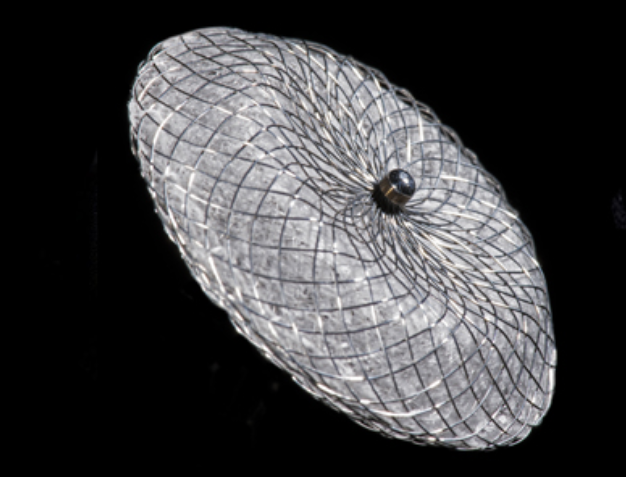
The Cocoon Atrial Septal Occluder is a self expandable and self centering double disk device manufactured from braided Nitinol wires coated with platinum atoms (up to 25 microns) using nano fusion technology by plasma deposition.
Compared to Nitinol Platinum coating makes Cocoon Occluders
More Biocompatible
Non Allergic
Non Corrosive
More Radiopaque for easy positioning in the defect
It is a double lumen balloon catheter with radiopaque marker bands to allow for radiographic measurement.
The Cocoon sizing balloon is specifically designed for sizing atrial communications.
The discs are connected by a waist at the center of the discs.
The discs are filled with polypropylene fabric which assist thrombogenicity in total occlusion of defect.
Ability to recapture and redeploy
0% erosion up to 43 months of follow up in more than 4.000 patients
95 to 100% device success rate from early european experience
Delivery Sheath with hemostasis valve adapter - used to deliver the device.
Dilator – used to ease penetration of tissue
Loader – used to introduce the Cocoon Septal Occluder into the delivery sheath.
Delivery cable – The device is screwed onto the distal tip of the delivery cable, which allows for placement and retrieval of the device. The delivery cable is packed separately from the other accessories. The delivery cable can be used with Cocoon Duct and PFO occluders.
The Cocoon Septal Occluder Accessory set is available in 6F, 7F, 8F, 9F, 10F, 12F and 14F sizes.
The Cocoon Sizing balloon is available in two sizes - 24mm (CAB24) and 34mm (CAB34)
Transcatheter closure of patent ductus arteriosis with a self-expanding platinum-coated nitinol device
Abstract
Aim: Assess the immediate and short-term results of transcatheter PDA closure with Cocoon Occluders.
Patient: 60 patients (13 males and 47 females; aged from 4 months to 65 years old) underwent catheter-based PDA closure
Conclusion: The devices were successfully deployed in all 60 patients. There were no serious procedural complications. Color Doppler demonstrated complete occlusion rate of 78.3%, 90.0% and 100% at 1 day, 1 month and 1 year after implantation, respectively. There was no statistical difference in serum nickel concentrations between pre- and post-implantation. Transcatheter PDA closure using a platinum-coated nitinol device can be performed safely and successfully. There was no evidence of nickel release or nickel reaction after device implantation. This device model may be an alternative for PDA closure, especially in patients with potential nickel allergy.